Vance Joy - Riptide
The song fits into the genres of indie folk and indie pop, which explains why the music video draws its influences from indie sub-culture, evident in the fashions and locations featured in the video. Indie sub-culture is heavily influenced by iconography which revolves around the natural world and vintage culture, and a lot of music videos that fit into the indie genre focus themselves around natural spaces and areas.
Video also relates to the idea of the male gaze, which was proposed by Laura Mulvey. The male gaze is a concept of second-wave feminism in which the camera (and subsequently, the viewer) are put into the perspective of a heterosexual man, thus allowing for the objectification and the sexualisation of women, as is evident in the Riptide video as one of the actresses fits the stereotypical view of beauty, in the sense that she is tall, slim, tanned and blonde. Additionally, as the lyric "I'm afraid of pretty girls" plays, the actress is depicted undressing.
By artistically depicting the lyrics word for word, the Riptide video is given an interesting twist, as the lyrics are presented in a creative way. The artistic nature of the Riptide video fits in well with the target audience, as the indie-subculture is also characterised as having a strong interest in art, literature and expressive albeit calming and relaxed music. One of the most interesting depictions in the video revolves around the lyrics "And I've got a lump in my throat 'cause you've gone and sang the words wrong". These lines are part of the chorus and thus feature in the song a number of different parts. With each depiction, a woman is shown singing, with subtitles appearing at the bottom of the screen, mimicking how the lyrics would appear on a screen during a karaoke-style video. However, the words do not match with the lyrics of the song, and with every depiction of these lyrics the on-screen words get more and more obscure and further away from the words actually sung. In addition to this, the woman lip-synching does not say the right lyrics, and her makeup gets messier with each depiction.
The Riptide video does not utilise the potential of star imagery, as the artist is not featured in the video. This is uncommon in most indie music videos, as using the artist's image is used as an exploitative method through which the artist becomes more well-known.
In conclusion, the Riptide video uses a range of different techniques in order to develop and capture interest, including exploiting the male gaze at times and creating imagery which correlates with the lyrics of the song.

Another example is from the lyrics of ‘running down to the riptide’ while the visuals show a midshot of someone running and then a shot of a actual riptide in the sea. This close up shot of a left hand holding a microphone is another example of the relationship as while this shot occurs the lyrics are ‘left hand man’.
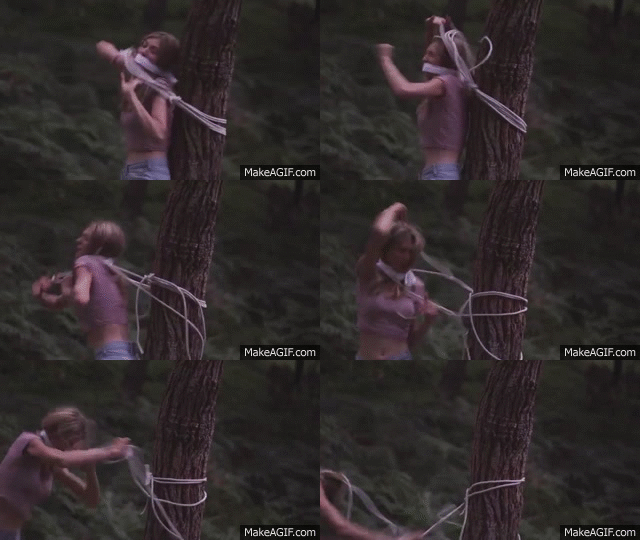
This is an example of the link as the lyrics are ‘come unstuck’ while the visuals are a midshot of a girl coming ‘unstuck’ from being tied to a tree.
Vance Joy - Riptide
Video also relates to the idea of the male gaze, which was proposed by Laura Mulvey. The male gaze is a concept of second-wave feminism in which the camera (and subsequently, the viewer) are put into the perspective of a heterosexual man, thus allowing for the objectification and the sexualisation of women, as is evident in the Riptide video as one of the actresses fits the stereotypical view of beauty, in the sense that she is tall, slim, tanned and blonde. Additionally, as the lyric "I'm afraid of pretty girls" plays, the actress is depicted undressing.
By artistically depicting the lyrics word for word, the Riptide video is given an interesting twist, as the lyrics are presented in a creative way. The artistic nature of the Riptide video fits in well with the target audience, as the indie-subculture is also characterised as having a strong interest in art, literature and expressive albeit calming and relaxed music. One of the most interesting depictions in the video revolves around the lyrics "And I've got a lump in my throat 'cause you've gone and sang the words wrong". These lines are part of the chorus and thus feature in the song a number of different parts. With each depiction, a woman is shown singing, with subtitles appearing at the bottom of the screen, mimicking how the lyrics would appear on a screen during a karaoke-style video. However, the words do not match with the lyrics of the song, and with every depiction of these lyrics the on-screen words get more and more obscure and further away from the words actually sung. In addition to this, the woman lip-synching does not say the right lyrics, and her makeup gets messier with each depiction.
The Riptide video does not utilise the potential of star imagery, as the artist is not featured in the video. This is uncommon in most indie music videos, as using the artist's image is used as an exploitative method through which the artist becomes more well-known.
In conclusion, the Riptide video uses a range of different techniques in order to develop and capture interest, including exploiting the male gaze at times and creating imagery which correlates with the lyrics of the song.

Comments
Post a Comment